An elevated slab for a Revolutionary War veteran and his wife. The two inscriptions were certainly done by the same craftsman, but from subtle differences in the thicknesses and forms of the letters it looks as though they may have been done at different times, suggesting that Jennet’s was added to Thomas’ already existing stone.
IN
Memory of
THOMAS Mc NARY Esqr.
Who departed this life on the
9th of July A.D. 1820 in the 76th
year of his age.
—
IN
Memory of
JENNET Mc NARY
Consort of
THOMAS Mc NARY
Who departed this life on the
15th of April A.D. 1828 in the 84th
year of her age.
Oak Spring Cemetery in Canonsburg has a number of slab stones elevated into table-like structures—an arrangement common in some old cemeteries. Obviously the props under these stones are newer than the stones, but they may have replaced older ones that were original. Old Pa Pitt simply doesn’t know whether these slab stones were always elevated or whether graveyard caretakers elevated them later, when they began to vanish under the ground.
SACRED
to the
MEMORY OF
SAMUEL WHITE
Who departed this life
May 12th 1837, In the
82nd year of his
age.
Samuel White, Sr. was a veteran of the Revolutionary War. He married a considerably younger woman named Mary:
SACRED
to the
MEMORY
of
MARY WHITE
wife of
SAMUEL WHITE
DIED
JUNE 12th, 1841 in the
76th year of her age.
In the short time between the death of Samuel in 1837 and the death of Mary in 1841, a new fashion in tombstones had swept over Western Pennsylvania. Samuel’s is a simple slab stone of the sort that had been made here since the late 1700s, but Mary’s is in what Father Pitt calls the “poster style,” with each line in a different style of lettering, like an advertising poster of the same era.
In memory of
James R. Sinclair
who departed this life
Jan. the 21, AD 1843.
aged 5 months.
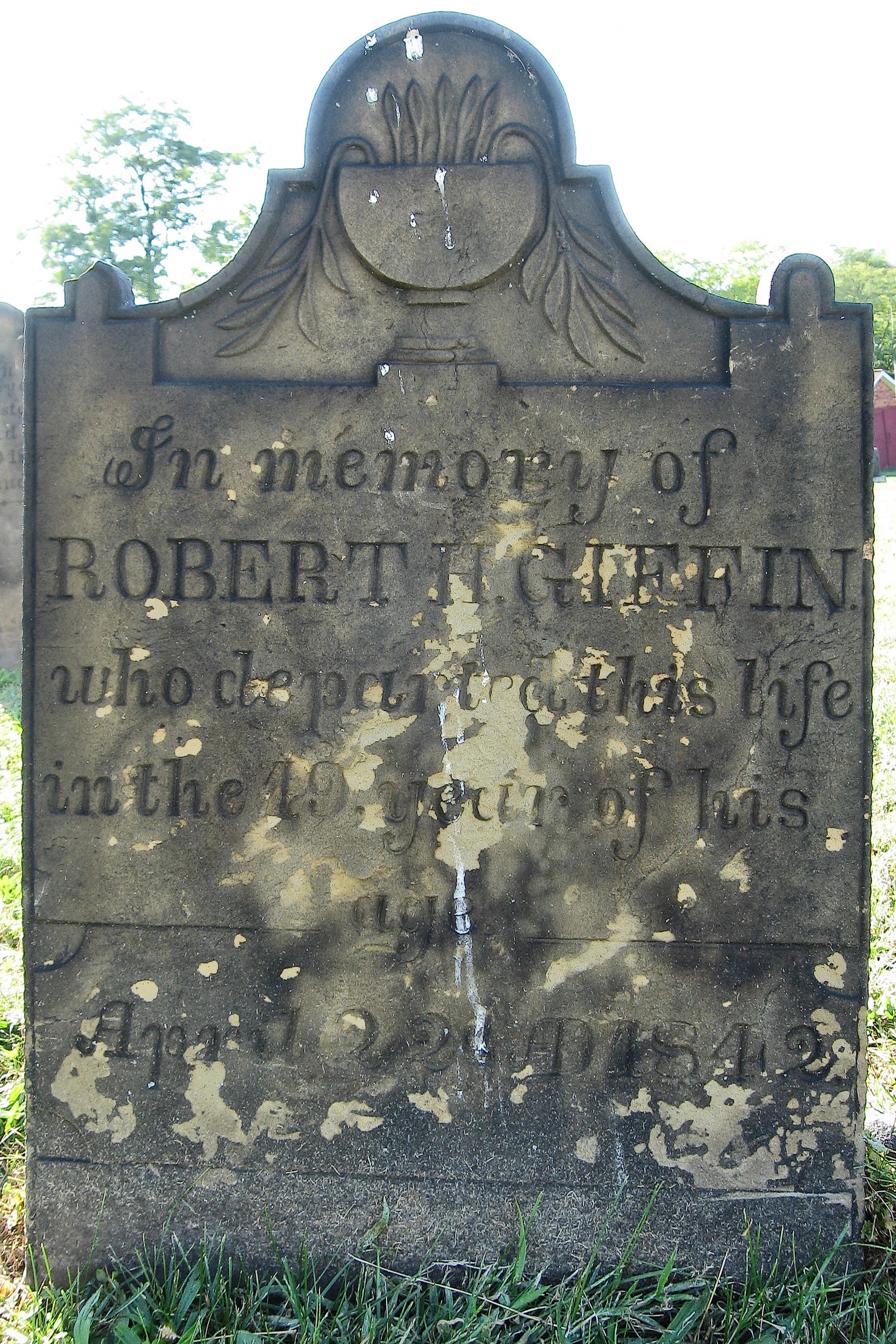
Two early-settler graveyards at opposite ends of Canonsburg have tombstones inscribed by some of the same local craftsmen. One of them, who worked in the 1830s and 1840s, is very easy to identify by three obvious quirks of his style:
He writes almost exclusively in italic letters.
He begins each inscription with a very distinctive capital I with curlicues.
He makes the abbreviation “AD” into a single character, with the right-hand stroke of the A serving as the left-hand stroke of the D.
In addition, if you paid him well enough, he was capable of some fine decorative folk-art reliefs.
The Giffin family, buried in Speer Spring Cemetery, employed him almost exclusively:
In memory of
ROBERT H. GIFFIN
who departed this life
in the 19 year of his
—age—
April 22 AD 1842
In memory of
ANDREW GIFFIN
who departed this life
in the 53d year of his
—age—
Aug. 12, AD 1841.
In
memory of
Samuel Webster Giffin
who departed this life
Sept. 18th, AD 1838, aged
9 months and 25 days
—
In
memory of
ELIZABETH McCOY
Consort of Andrew H. Giffin
who departed this life
May the 15th AD 1842, in
the 36th year of her age
— — —
Following his usual method of naming anonymous craftsmen after a distinguishing characteristic of their work, Father Pitt will call this artist the Master of the Curlicue I.
To round out the Giffin family plot, we include one broken tombstone done by a different craftsman:
IN
Memory of
ANDREW RAY
GIFFIN, who—
departed this life,
Febr. 11th, 1836
in the 13th year of
his age.
A simple rectangular stone is unusual in this era. This stone commemorates two Andrew Russels (note the spelling of the name). The first died in 1808 at six years old. (If a tombstone says “in the xth year of his age,” it usually means the deceased was x years old, though technically an x-year-old is in the x+1 year of his age.) The second died in 1814 at 82 years old, so he was probably a great-grandfather of the first.
Father Pitt believes that this stone was put up in 1808, and the inscription for Andrew Russel, Sr., added in 1814. His evidence is, first, the word “Also,” and second, a demonstrable difference in the styles of lettering between the two inscriptions. The second is well matched to the first, but probably by a different hand, one that made thinner letters—or possibly by the same stonecutter after six more years of practice.
IN MEMORY OF
ANDREW M. RUSSEL
who died
Feb,y 27th 1808;
in the 6th year of his age.
—
ALSO
ANDREW RUSSEL, Senr
died
June 20th 1814;
in the 82nd year of
his age.
Only about half this tombstone is visible above ground—enough to tell us the name and death date (1832), and to show us that the stone itself was a very attractive piece of folk art.