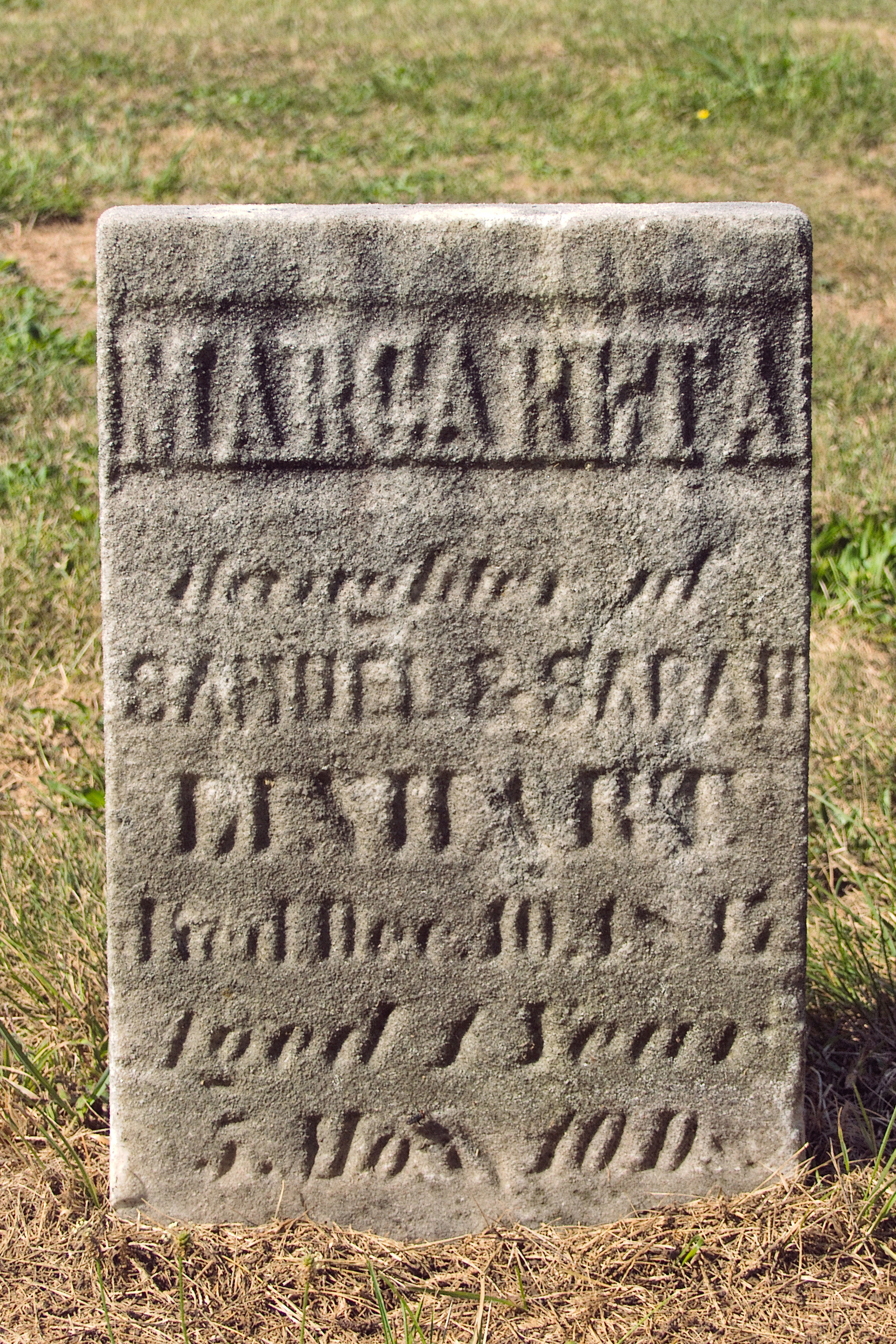
MARGARETA
daughter of
SAMUEL & SARAH
LINHART
died Dec. 10, 1845
Aged 1 Year
5. Mos. 10 Ds.
A good example of what Father Pitt calls the “poster style” that became popular in the 1840s and 1850s: a plain rectangle on which the inscription is engraved in a wide variety of lettering styles, like an advertising poster of the same era.
Here in Zion Cemetery, Whitehall, is an interesting document in the German-American immigrant experience.
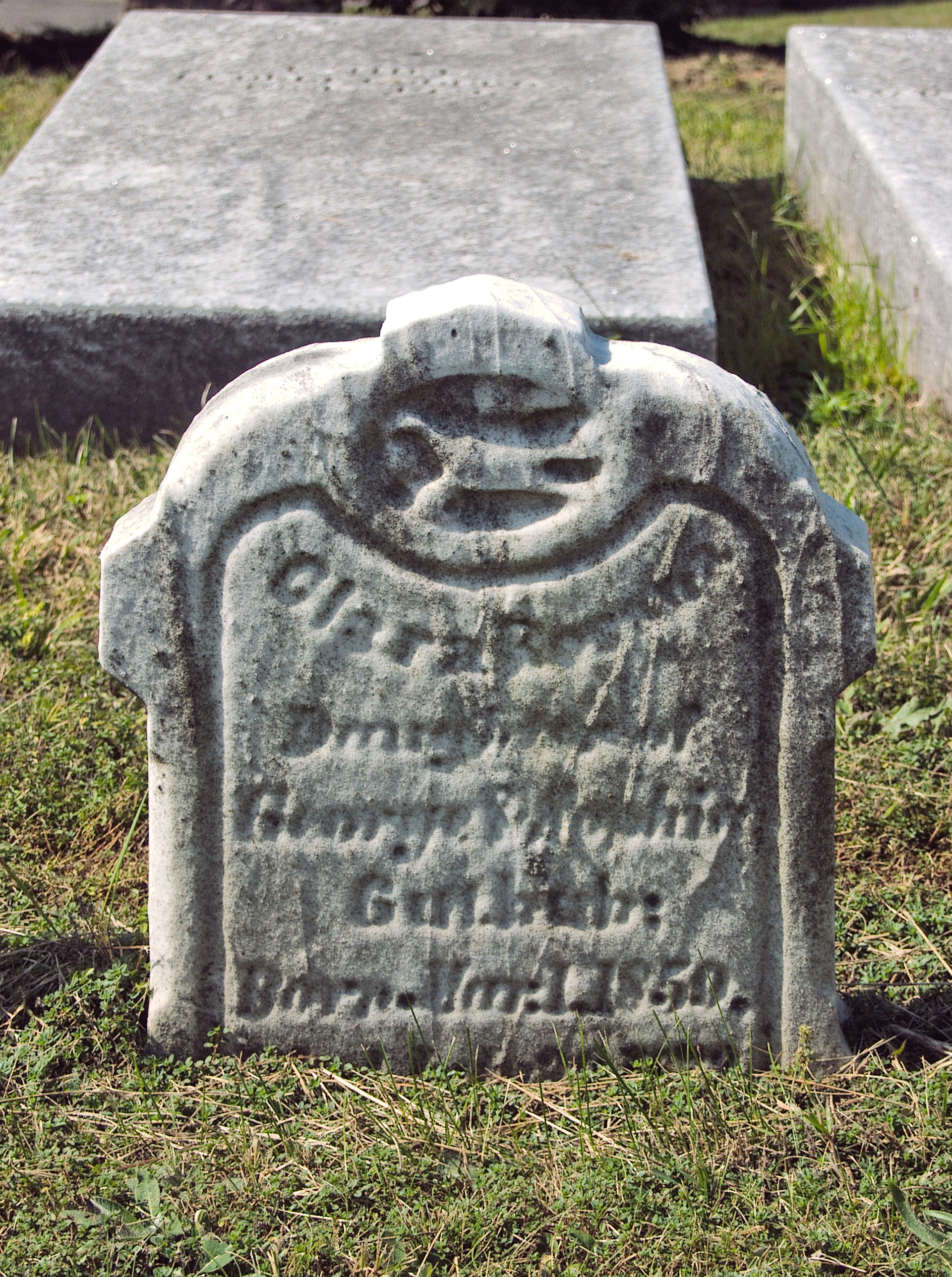
George and Sophia (Klotz) Gutbub had a number of children who did not survive to adulthood, all buried in a row in the family plot. Those children all died with the name Gutbub—but their father did not.
In 1896, Sophia died as well, and was buried under the spelling “Guttbub”:
George later married a much younger woman, and at some point they decided that “Gutbub” was entirely too German. Father Pitt suspects that point may have come during the First World War, when some German-American families had good reason to fear for their lives.
So they Anglicized their name to “Goodboy,” and the name has stuck with their family ever since.
The plot is still in use, and all subsequent burials bear the name Goodboy. And, as you see in the picture at the top of this article, the family monument has had “Goodboy” added at the bottom, so that all the Gutbubs become Goodboys retroactively.
Thus the story of one family becomes the story of the Americanization of the Germans in America, who are America’s largest, but arguably America’s least visible, immigrant group.
The Senn family plot carries the rustic-stump metaphor to an odd extreme. One central stump is surrounded by small stumps, one for each deceased family member. If the stump represents a life cut off, then the most descriptive term for the metaphor applied to a whole family this way is “deforestation.”
In memory of
James R. Sinclair
who departed this life
Jan. the 21, AD 1843.
aged 5 months.
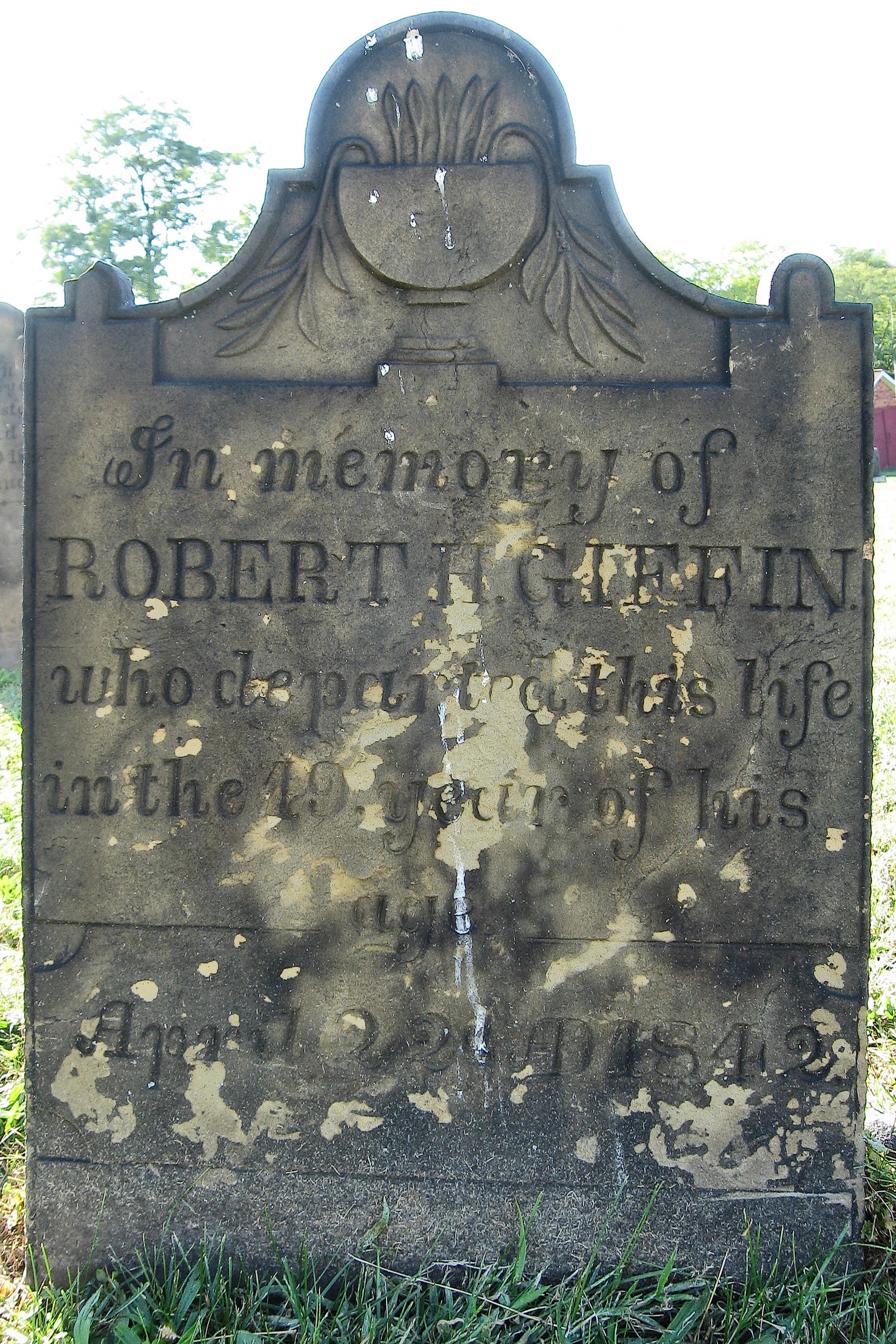
Two early-settler graveyards at opposite ends of Canonsburg have tombstones inscribed by some of the same local craftsmen. One of them, who worked in the 1830s and 1840s, is very easy to identify by three obvious quirks of his style:
He writes almost exclusively in italic letters.
He begins each inscription with a very distinctive capital I with curlicues.
He makes the abbreviation “AD” into a single character, with the right-hand stroke of the A serving as the left-hand stroke of the D.
In addition, if you paid him well enough, he was capable of some fine decorative folk-art reliefs.
The Giffin family, buried in Speer Spring Cemetery, employed him almost exclusively:
In memory of
ROBERT H. GIFFIN
who departed this life
in the 19 year of his
—age—
April 22 AD 1842
In memory of
ANDREW GIFFIN
who departed this life
in the 53d year of his
—age—
Aug. 12, AD 1841.
In
memory of
Samuel Webster Giffin
who departed this life
Sept. 18th, AD 1838, aged
9 months and 25 days
—
In
memory of
ELIZABETH McCOY
Consort of Andrew H. Giffin
who departed this life
May the 15th AD 1842, in
the 36th year of her age
— — —
Following his usual method of naming anonymous craftsmen after a distinguishing characteristic of their work, Father Pitt will call this artist the Master of the Curlicue I.
To round out the Giffin family plot, we include one broken tombstone done by a different craftsman:
IN
Memory of
ANDREW RAY
GIFFIN, who—
departed this life,
Febr. 11th, 1836
in the 13th year of
his age.
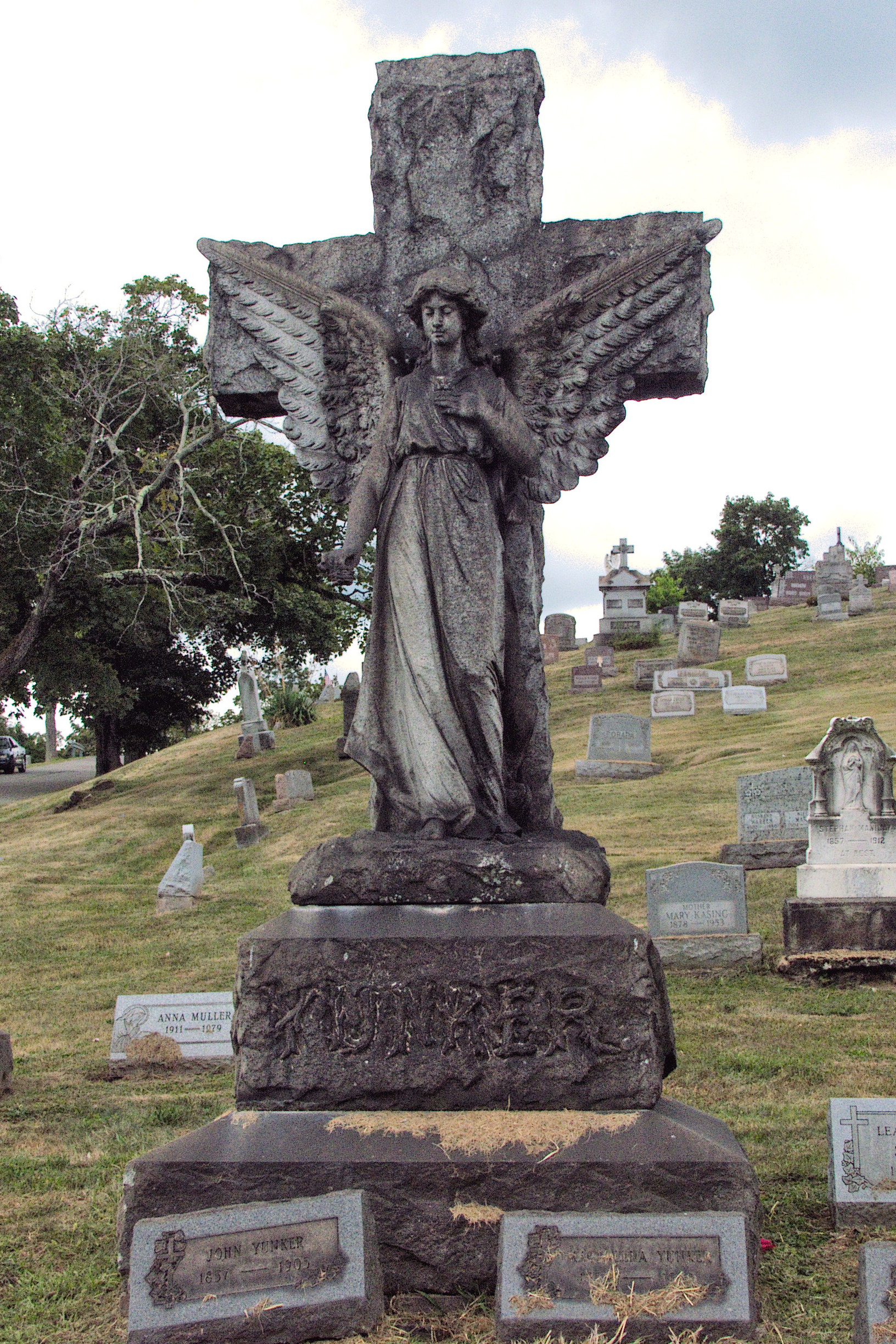
A rustic stone cross with a very good flower-dropping angel standing on a rock, and the family name spelled out in twigs on the base. It probably dates from about 1905, when John Yunker was buried here.