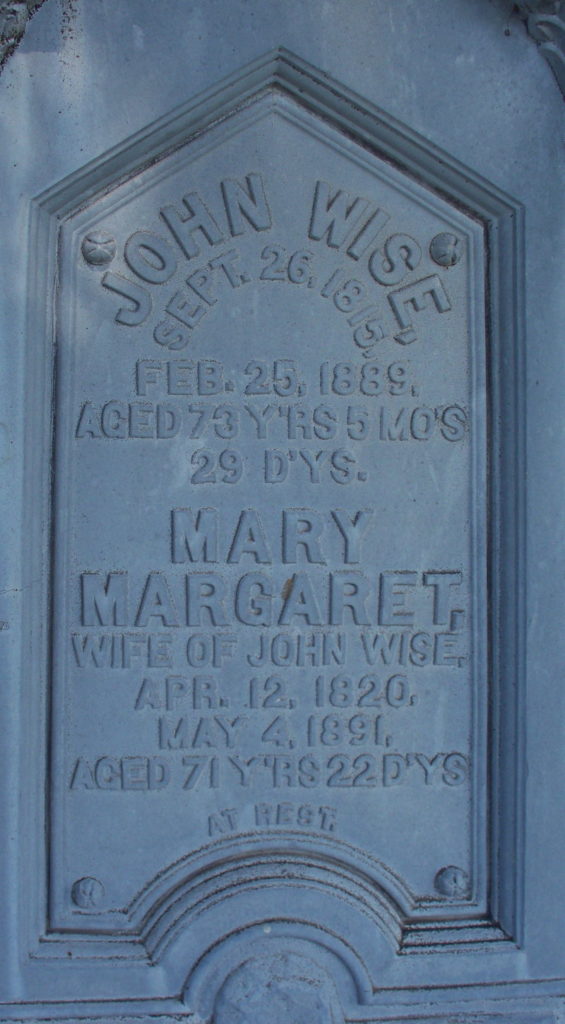
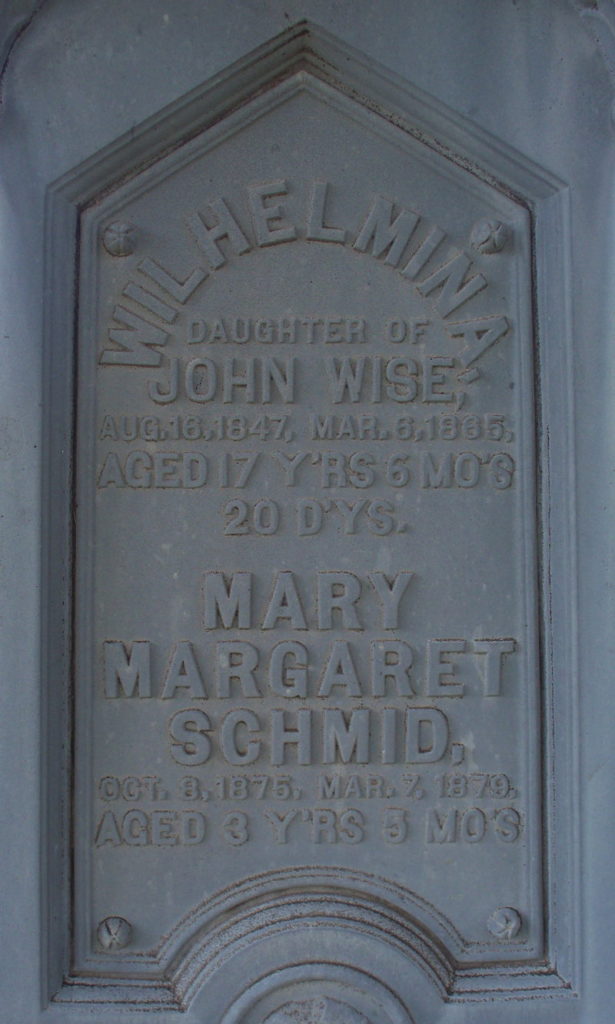
A zinc or “white bronze” monument, still in very good shape (as they usually are), except that one of its panels is missing.
There is a small genealogical mystery here, and Father Pitt does not have the time to research the answer to it. The monument remembers John (died 1889) and Mary Margaret (died 1891) Wise, as well as Wilhelmina, “daughter of John Wise,” who died at 17 in 1865. But who is the little girl Mary Margaret Schmid, who died at three years old in 1879? Was she a granddaughter, born to another Wise child not mentioned here, and named for her grandmother? Perhaps the answer was on that missing panel.
The McFarlanes were early settlers in the South Hills; in fact a McFarlane donated some of the land for this burying-ground. This child died at five and a half years old; and though his epitaph is partly buried, it is a famous quotation, which we give here in full:
Read this and weep—but not for me; Lament thy longer misery. My life was short, my grief the less; Blame not my haste to happiness.
This poem was quoted by Benjamin Franklin (from whom perhaps the McFarlanes took it) and many others as occurring on a tomb in a small English village, and so it did. But Father Pitt, with the aid of the all-knowing Internet, has done a bit of original research for you, and believes that he has traced the source ultimately to a poem in the back pages of a magazine.
In a very scholarly book of Admissions to the College of St. John the Evangelist, we find a note saying that the poem occurs on a monument in the church of Elton, Northamptonshire, where a child named Elizabeth Richardson Standish was buried; she died in May (the date was illegible) of 1731.
But old Pa Pitt has found the poem published in the Gentleman’s Magazine for April 1731. What could be more natural than that the bereaved father should remember a consoling poem titled “An EPITAPH on the Tomb Stone of an Infant” from last month’s magazine, and cause it to be engraved on his daughter’s monument?
As for this tombstone, it is a splendid effort by the local stonecutter, with a tree (perhaps a weeping willow?) and some fine pen-like flourishes. Those things more than make up for the little difficulty with fitting the final E in the name “McFarlane.” Following his usual method, Father Pitt calls this artist the Master of the Extended Bowls, from his easily identified trick of extending the bowls of letters like P, R, and D upward into a swooping flourish. We also find his work at least as far out as Canonsburg.
A curiously shaped rustic mausoleum with Gothic pilasters that seem a little like an afterthought. As we have mentioned elsewhere, all the mausoleums in the South Side Cemetery are missing their doors.
A small rustic temple with smooth Doric columns and a cross. All the mausoleums in the South Side Cemetery are bricked up like this; probably they all had bronze doors, and every one has been stolen.