Sarah Coleman Miller is marked as “Founder of Womens Hospital of Pittsburgh.” If this is a predecessor of Magee-Womens, it is interesting to note that the institution still cannot afford an apostrophe after all these years.
The monument itself is unique, a romantic impression of a classical arch. The details are classical, but the arrangement of them is entirely fantastic, like a half-remembered dream of an ancient temple.
An angel seems to be gazing in wonder at a cross, which would be theologically correct and profound. She is probably a dealer’s stock model, but she is a good one, and well preserved.
Herr Fromm (the name is illegible on his marble headstone) died in 1894, so that is probably about the date of this monument.
Note the stock stones with “Father” and “Mother,” but inscriptions in German.
The Zelienople Community Cemetery, as it is now called, has grown into a fairly large institution with a surprisingly huge community mausoleum. One section of it, however, is the old town burying-ground, and here the early settlers rest under locally-cut tombstones, many of which are still legible after the better part of two centuries. Here we gather a number of tombstones that show the clearly identifiable style of the same stonecutter, who was prone to errors, which he corrected by any means necessary. He worked for many years, but never overcame his sloppiness. The loop around the I in “In memory,” the strangely narrow S, and the form of the ampersand are all distinctive.
“In memory of A Catherine GoehrinG born April 2 1747 She lived in marri age with Wm H Goehring 52 years & deid March 12 1821 Aged 74 years”
One might think that the one word a stonecutter would know how to spell would be “died.”
“Hier ruhen die Gebeine der verstorbenen Salome Catherine Roth sie war [Geboren Den 22]en April 1837 Gestorben Den 18ten April 1841 Jhr Alter hat sie gebracht auf 3 Jahr 11 monat und 27 Tage”
Father Pitt’s rough translation:
“Here lie the bomes of the deceased Salome Catherine Roth. She was born the 22nd of April 1837 and died the 18th of April 1841. She reached the age of 3 years, 11 months, and 27 days old.”
Although this stone is in German, the letter forms and the little flower or star pattern at the top mark it as the work of the same stonecutter, who apparently messed up the word “Geboren” and the date so badly that he had to slice out that whole section of the stone and start over.
“In memory of Elisabeth Hoon who died Desem the 16 1841 Aged 11 years 8 months & 17 days.”
A stonecutter should also learn to spell all the months.
“In memory of James Son of Adam Goe[h]ring who died Jan 12th 1841 Aged 4 years & 22 Days”
Here he left the H out of “Goehring” and had to stick it in above the name.
“In memory of Mary J Harris who died Feb 8 1833 Aged 1 year 8 months & 11 days”
“In memory of Meihael Weiss died Sept 11th 1837 Aged 77 years 9 months & 21 Days.”
One is tempted to read “Meihael” as a misspelling of “Michael,” but it seems to be not unheard-of as a German name.
“In memory of Marion Ross goll Who departed This life oct 3 1828 in her 9th year”
Father Pitt believes that “goll” is Marion’s family name, but he is not absolutely sure. It is also possible that the name is “Rossgoll.”
It must have been hard to maintain an optimistic outlook as a stonecutter in nineteenth-century rural America, when stones for children made up the larger part of one’s business.
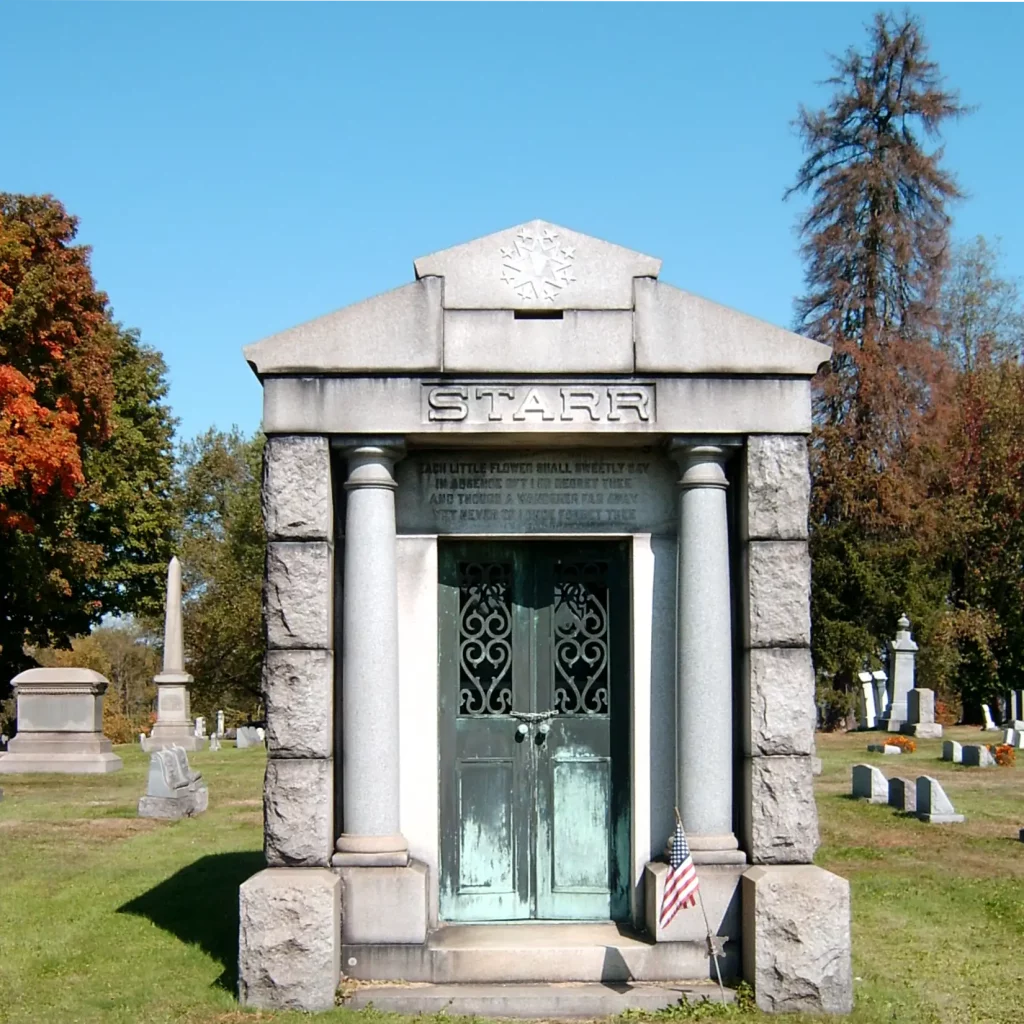
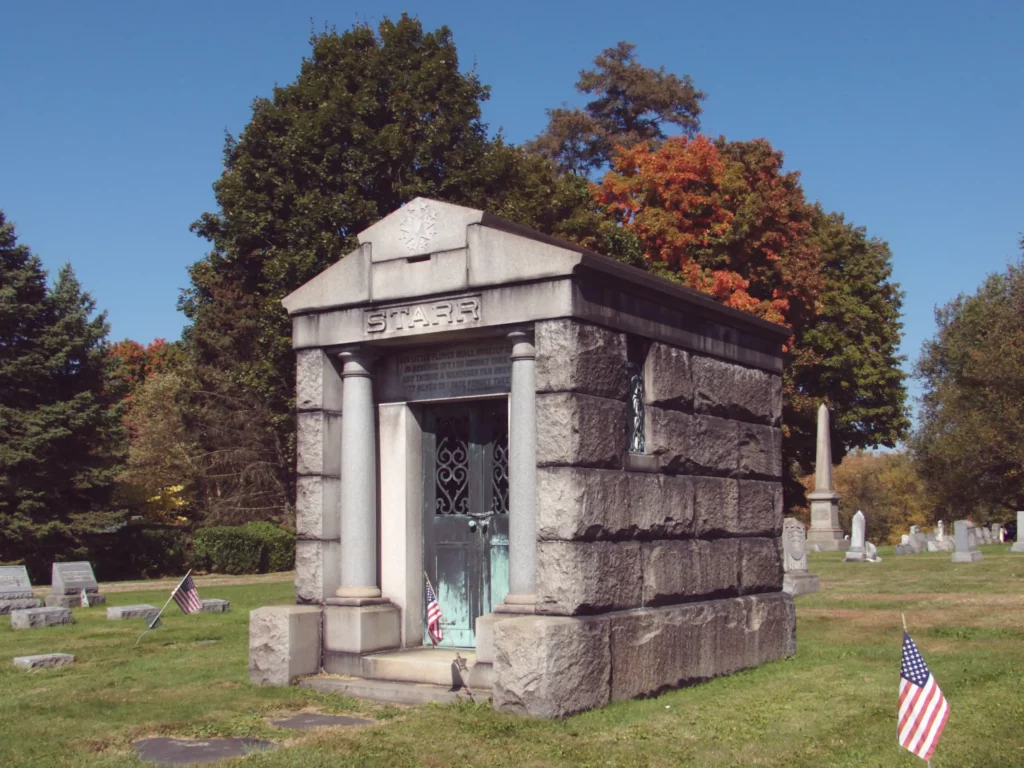
The only private mausoleum in the cemetery, this is not quite as grand a construction as some of the ones in the great city cemeteries. But it must have impressed the neighbors in this little country town.
The epitaph is a version of a poem commonly associated with valentines:
Each little flower shall sweetly say, In absence oft I do regret thee; And though a wanderer far away, Yet never do I once forget thee.
The biggest monument in this little cemetery, and quite expensive with its polished granite. One of its columns has been broken, but it is otherwise in fine shape; polished granite lasts indefinitely. John Sutton died in 1884, and that is probably about the date of this monument.